As with many aspects of modern life that we take for granted, it’s easy to think of home shopping as a recent phenomenon, made possible by the telephone and the internet. The reality, I suspect, is that it dates from ancient times, when human beings first hit upon the idea of getting someone else to do their bidding. These days, with a few niche exceptions, it involves mutual agreement rather than the lash of a whip, and as technology has developed, the level of interaction between customer and service provider has been reduced to a few clicks of a mouse. That said, the basic idea is the same as it has been for thousands of years. Nevertheless, an important difference appears to be emerging. Whereas home shopping has traditionally been largely a matter of customer service and convenience, it has more recently become an existential necessity for those businesses which have closed their doors physically to customers amidst efforts to control the spread of Covid-19 and as socially distant interaction becomes the new norm. The balance has shifted, and now that Mohammed is no longer able to go to the mountain, the mountain is being forced to find inventive ways to come to him instead.
For those with an existing online presence, who aren’t reliant entirely on physical interaction to do business, social distancing reinforces well-established shopping habits and makes little difference to customer relationships, beyond testing logistics and supply chains as more people move over to doing business remotely. Given that I live in London and Bettys is based in Yorkshire, I have been accustomed for several years to buying treats online and having them delivered. It isn’t the same as visiting Bettys in person of course, but owt’s better than nowt as they say in Yorkshire, and the Bettys online shop is a great way of ensuring that I am never far away from a Fat Rascal.
Businesses which are reliant on physical interaction with customers, however, have had to face the challenge of modifying their operation to accommodate customers who are no longer able to visit them in person. For me, this is where the greatest level of ingenuity can be seen, especially amongst restaurants and cafés whose business model is entirely dependent on people eating on the premises. The challenge for them is to create something with the convenience of a takeaway, without reducing the experience to a watered-down and overpriced approximation of the “real” thing. Restaurants which have traditionally seen themselves as superior to takeaways are now competing with them for my business, and have been forced in a very short space of time to get to grips with the practicalities of food delivery which takeaways overcame years ago. Diners who might have looked down in the past on takeaways as an inferior indulgence are starting to see the potential of food delivery as a comforting treat whilst in isolation. Nevertheless, while they might yearn for the convenience of eating restaurant quality food at home, they are unlikely to repeat the experience if the food doesn’t survive the journey and they end up feeling that they would have been better off going for the fish and chips they previously would only have considered eating whilst weekending in Aldeburgh. In that context, I was pleased, and more than a little jealous, to see Bettys rise to the challenge by coming up with a takeaway version of their afternoon tea, available to those lucky to live close enough to be able to collect it in person.
Since the Government’s response to Covid-19 moved from the Contain to the Delay phase and we have been in what is commonly referred to as lockdown, I have ordered food for consumption at home more often than before. Although it will come as no surprise to you that my contribution to the economics of food is more on the demand than the supply side, you might be more surprised to learn that I rarely order takeaways. As a result it struck me and Nick (aka the fella) that a good way for us to play our part in stimulating the economy would be to support restaurants and food outlets we would previously have visited in person, by taking advantage of their “at home” offering. Particular high points so far have been the reliability of the local Indian restaurant and fish and chip shop, whose Deliveroo offering is reassuringly the same as ever; the attempt by the family-run pizzeria down the road to make our meal a little more special by lovingly arranging the charcuterie, bread and olives we ordered to go with our pizza in a little box with rocket and parmesan; and the three course dinner with wine we ordered from a really good restaurant in Islington, which was phenomenally good, barring a rather rubbery poached egg (entirely our own fault for not eating it straight away) and a panna cotta with such a good wobble that it arrived looking more like cottage cheese (but still tasting delicious). We’ve also tried virtual dining with friends, which was hilariously enjoyable and felt a bit like participating in a surreal Richard-and-Judy-style early evening television programme, with a “show and tell” of each course. As far as Bettys is concerned, we’ve had two experiments, both highly amusing.
The first Bettys experiment involved an order in early March 2020, when the Government response to Covid-19 was still in the Contain phase. I decided to give up not eating Fondant Fancies for Lent and placed an order in the usual way. As so often happens when shopping online, I ended up ordering way too much. One thing led to another and the possibility of free delivery enticed me to order a few extra items, including Fat Rascals, Curd Tarts, Yorkshire Gingerbread and Gooey Rascals (a variant of the Fat Rascal and something I was interested in trying). Rather than reduce the size of the order (my inner Yorkshireman shouted “Ow Much?” too loud at the prospect of not benefiting from free delivery), I decided to make a virtue out of a necessity and invite some fellow cake lovers round shortly after the delivery was scheduled to take place. Unfortunately, with the prospect of lockdown happening faster than anticipated, I decided with a heavy heart to postpone the party. Amidst increasing concerns about the potential effect of the virus on business and the wider economy, I thought it best to show some solidarity with Bettys by not cancelling the order, meaning that a huge amount of cake was coming my way, some of which couldn’t be frozen and would need to be eaten pretty fast. Nevertheless, every cloud has a silver lining, and the idea of following the Marie Antoinette approach to economic stimulus was more than a little appealing.
The cakes arrived a couple of weeks later, as always beautifully packaged. Once I had taken everything out of the box and laid it on the kitchen table, it was as if a de facto pop-up branch of Bettys had opened in Dalston, with one eager customer.
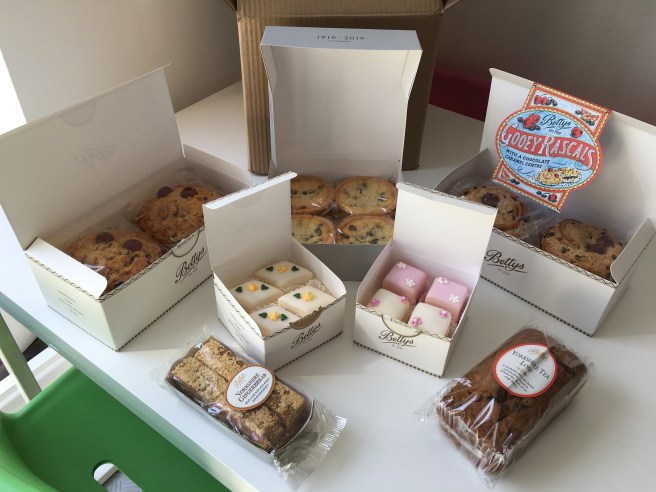
The only downside was that the fella and I weren’t going to be able to enjoy eating the cakes with anybody else in person. We decided instead to give some to an elderly neighbour, as well as to use our daily exercise allowance to walk a parcel of goodies across to a fellow foodie partner-in-crime, to put some items in the freezer, and to organise an afternoon tea party for two the following day, designed to simulate the Bettys experience as far as possible with limited resources.
In the meantime, we decided to try a Gooey Rascal. I must confess that when I first heard of them, I was more than a little doubtful. I’ve written at length about my love of the Fat Rascal, and there was something about this attempt to improve on perfection that struck me not only as unnecessary, but also futile and slightly disrespectful. A hot chocolate-chip rock cake? A scone stuffed with chocolate spread? It sounded wrong on every level, and I shuddered inwardly at the prospect of an old friend being reduced to a chocolate & orange abomination, given the Fat Rascal’s characteristically citrus flavour. However, curiosity and my love of dirty food more generally got the better of me. I knew I wasn’t going to be able to rest until I had tried one, if only to be able to speak from experience about how bad they were. I threw caution to the wind and popped one in the oven. Despite my reservations, it turned out to be totally delicious.
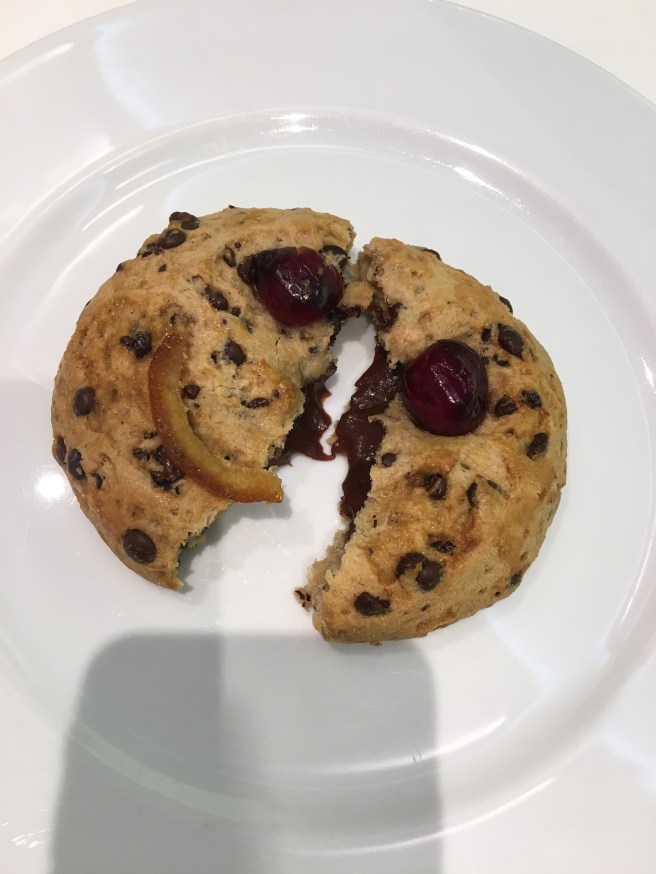
The best way to think of a Gooey Rascal is as something totally different from a Fat Rascal. This will enable you to enjoy it without feeling a sense of divided loyalty or the need to say which one is better than the other. The most striking thing about the Gooey Rascal, when you pick one up for the first time, is how much smaller and heavier it is than a Fat Rascal. It also doesn’t have the distinctive citrus flavour when you bite into it, which for me is a very good thing, given my dislike of anything which nods in the direction of chocolate & orange together. The feature making it gooey is a chocolate caramel centre. This goes extremely well with the buttery exterior whose texture, incidentally, is denser than that of a Fat Rascal, rather like a very soft and crumbly chocolate-chip cookie. In common with the Fat Rascal, the Gooey Rascal is better served warm (like a chocolate fondant), meaning that for the thrill-seekers amongst you there is the added frisson as you bite into one of not knowing if it’s going to burn your tongue. Not quite Russian Roulette, but speaking as someone who regularly scalded his tongue whilst drinking hot chocolate as a child, sufficiently unpleasant to make it an experience best avoided. Another thing best avoided, if you don’t like chocolate & orange together, is to bite into one without first removing the candied orange peel smile. In short, the Gooey Rascal can be summed up as the love child of a Pain au Chocolat and a Pop Tart; dirty and yet posh at the same time, rather like Marie Rose sauce served in a silver dish.
For afternoon tea the following day, we decided to make more of an effort than usual by having tea from cups with saucers and some sandwiches. Unfortunately we didn’t have any Bettys Tea Room Blend, so improvised with Yorkshire Tea. As for the sandwiches, let’s just say they weren’t dainty and I didn’t cut the crusts off. I went for cheese and pickle and the fella went for corned beef. I’m not sure I should admit that we bought a couple of tins of it as a dirty treat during lockdown, but confession is good for the soul and it was delicious. One more confession: two rather large hot cross buns eaten before Easter. In our defence, they were a gift from our downstairs neighbours and would otherwise have gone stale. On the top tier we went for a Gooey Rascal, a Curd Tart, a pink Fondant Fancy and a Lemon Fondant Fancy. Of course, if we had been in a branch of Bettys or in a position to benefit from the takeaway afternoon tea, there would have been an Engadine Slice on the top tier of the cake stand. This is the one item I really wish Bettys would sell online.
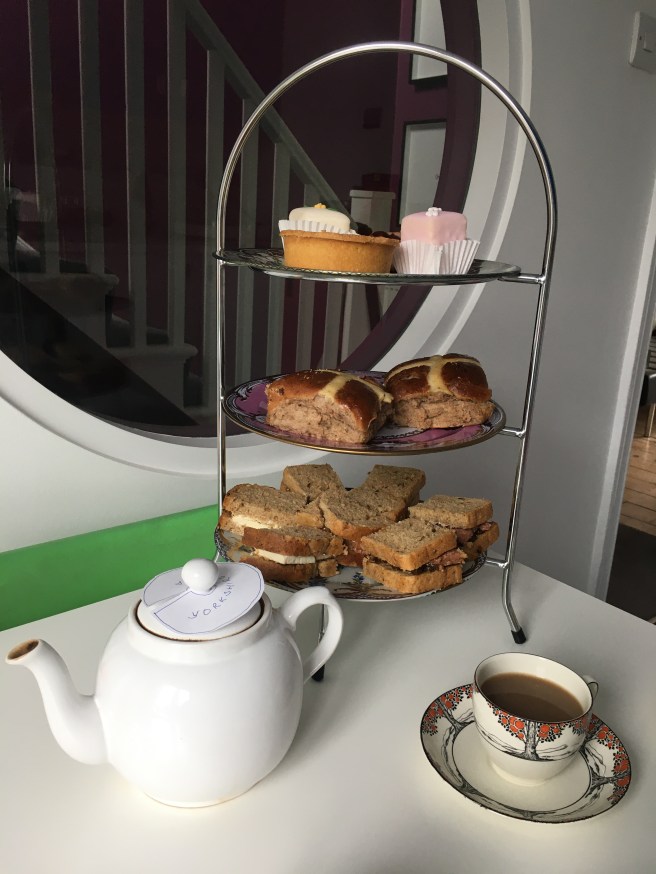
It will come as no surprise to you to read that I possess a cake stand. Not as elegant as the custom-made Bettys ones, but suitably tongue-in-cheek, with metal plates from the gift shop in the Wallace Collection, imprinted with designs from some of the more elaborate items in the ceramics section. The eagle-eyed amongst you will also have noticed that final touch for an authentic Bettys experience: the all-important circular label on the lid of the teapot indicating its contents.


A couple of days after giving my neighbour the Yorkshire Tea Loaf and a couple of Fat Rascals, I had a socially distanced chat with her from my balcony as she sat on the steps leading down to her garden. She told me that she used to have a friend in Harrogate, who had taken her to a tea room there. When we had previously spoken, she had been unable to remember the name of the tea room she had visited all those years before. Of course, it turned out to be Bettys. As well as finding a good home, the Yorkshire Tea Loaf had brought back some happy memories for an elderly neighbour and provided an all-important opportunity for us to have a chat in the afternoon sunshine.
Enjoyable as the first iteration of the pop-up Bettys afternoon tea was, it lacked the very thing that the original tea party was intended to provide: an opportunity to catch up with friends over tea and cake. In order to achieve this, a more technological solution was required. Necessity being the mother of invention, the idea for the second Bettys experiment was born: a virtual afternoon tea party.
The first challenge was to arrange for a selection of items to be delivered on the same day to each of the guests who would originally have been physically present. Given that I was throwing a tea party, it didn’t feel right to expect everyone to provide their own cakes and tea. On top of that, my experience with virtual dining is that it isn’t as much fun unless the food is provided by the same restaurant. As a result, it struck me as essential that I should provide a choice of cakes. Miraculously, everyone would be at home, not only on the day when the cakes were scheduled to be delivered, but also on the day when the tea party was due to take place. Six online Bettys orders later, I was good to go. The evening before the cakes were due to be delivered, I received six messages confirming that they had been despatched. The following morning I received six further messages confirming when they would be delivered. By early that afternoon six packages, each containing a Yorkshire Tea Loaf, some Fondant Fancies and a box of Bettys Tea Room Blend teabags, arrived safely thanks to the combined efforts of Bettys, DPD, Chris, Patrick, Mckenzie, Ioan, Elton and the rather romantically named Byron.


The second challenge was to ensure a sufficient level of consistency so that the virtual tea party felt like a shared experience rather than a series of separate tea parties taking place at the same time, without stifling the creative potential arising from everyone being physically separated from each other. It struck me that the best way of achieving this was by delivering a core selection of items to each guest rather than the full range that would have been on offer if everyone had been physically together in my flat. The creative potential of each guest could then be expressed through such matters as their choice of crockery, additional home-made or location-specific treats, the all-important savoury items making the event more than just an orgy of cake consumption, and where each participant decided to locate their web cam.
The tea party, which was conducted by Zoom, ran smoothly from a technological point of view and involved a considerable amount of showing and telling of crockery, cake presentation, savoury items (home-made and shop-bought), and standards of dress (both above and below the waistline). The conversation was risqué to put it mildly, and certainly not something we would have got away with in Bettys. In order to spare everyone’s blushes I won’t reveal who was in attendance. Suffice it to say, however, that the party involved a doctor working in an A&E department with many tales to tell of patients presenting with discomfort stemming from imaginative use of a wide selection of household objects, and two members of the criminal bar with very niche areas of expertise.
Once we are on the other side of the pandemic, I’m looking forward to some of the positive things that will by then have become established behaviour continuing in one form or another. It’s easy to blame technology for contributing to greater social isolation and more insular attitudes, as well as to focus on the superiority of physical interaction. Nevertheless I imagine that without its virtual counterpart, lockdown for the majority of us would have been significantly more isolated and difficult to endure. It’s a pity that there is a tendency to focus on technology in itself as the cause of so many problems in the world, when it’s how we all choose to use it which determines the effect that it has. It’s also a pity that it has taken such a drastic curtailment of our ability to interact physically for the benefits of virtual interaction to be widely appreciated. Interacting with someone virtually will never be the same as interacting with them physically, but that’s not to say that physical interaction is necessarily always better. After all, physical interaction has its drawbacks too. Perhaps it’s better to see them both as differently imperfect, together providing a greater range of ways of keeping in touch, each better suited to particular scenarios than the other. Rather like Covid-19, technology brings out the worst in us, but it is also capable of bringing out the best. More interaction is better, and if that means doing some of it virtually, then so be it as far as I’m concerned.
My dad is now on Skype and we regularly engage in chats via instant messaging in between phone calls. I now socialise regularly with groups of friends who live far enough away from me and each other to make meeting up in person a rare occurrence. I have seen and heard more of friends living in Hong Kong, Canada and the USA in the past few weeks than some friends who live just up the road. I’m also amazed by how much more I have seen of other friends who live locally in the last few weeks compared with how much I saw of them during the whole of last year. Far from undermining social interaction, technology has reinforced and transformed it for me. Looking further ahead, I’m dreaming of the day when Bettys can email their full range of products to a 3D printer connected to my oven, ready to be baked and decorated for me remotely. In the meantime, I’ll happily settle for some cakes ordered online, delivered separately to me and a few friends, and shared virtually over a cup of tea via Zoom. Who knows, one day it might even involve an Engadine Slice.

 What I learned today...