
My name is Geoff and I’m a perfectionist. I write these words not to trivialise the suffering of alcoholics, for whom this kind of admission is often the first step on the road to recovery, but to emphasise the possibility of having an unhealthy or abusive relationship with anything that you use as a coping mechanism, however socially acceptable it may be. Just as those with substance abuse issues often use alcohol or other drugs to alleviate deeper anxieties, I find relief from my own insecurities by getting things right. Rather like having a drink in the pub with friends, a desire to get things right isn’t ordinarily much of a problem and is often seen as a positive thing. However, in the same way that alcohol consumption can easily get out of control, good attention to detail and a strong work ethic can, given the right triggers, become a paranoid obsession.
It’s hard to pinpoint when it all started. My grandmother was a perfectionist whose own obsessions percolated through the generations, so it’s pretty clear that a lot was baked in during childhood. What really brought matters to a head, however, was practising as a solicitor in a large City law firm. Despite feeling like a misfit pretty much from Day 1, I fitted in very well there as someone with a need to over-achieve in everything that I did. Being surrounded by high-flyers, however, made me acutely aware of my own inadequacies and, as well as feeding my impostor syndrome, fanned the fear of failure which has motivated me most of my life. Looking back, I’d be surprised if many of my colleagues weren’t motivated by the same fears and insecurities, especially some of the partners. The difference between us though was that those fears and insecurities took them all the way to the top. From my childhood, I remember an advert for the Army which boldly stated “If you’ve got it in you, we’ll bring it out”. I’ve yet to think of a better recruitment slogan for the legal profession.
Practising as a solicitor in a City firm was for me a lens bringing into focus a number of factors which individually were fairly manageable, but together formed a perfect storm. First, I qualified in the middle of the economic recession of the early 1990s and wasn’t kept on by the firm where I did my training contract. Even though I landed a job in-house immediately afterwards and had the consolation of knowing that no-one else in my intake had been kept on, the feeling of rejection hit me hard and left me with a sense of unfinished business, as well as a heightened need to prove myself. Second, I’ve always suffered quite badly from impostor syndrome, which wasn’t helped by the fact that the process of interviewing for a job back in the City consisted mostly of conversations with people who considered my time spent working in-house and teaching to be little better than a period of unemployment; something to be justified and overcome. I was taken aback to put it mildly when I was offered an interview, let alone a job, at a firm that had turned me down for a training contract whilst at university. Despite them talking about my experience in a positive light and offering me the job by the time I got home from the interview, I was convinced deep down that they only did it because they were desperate, and half-joked that if they didn’t sack me for incompetence by lunchtime on my first day, I might stand an outside chance (I worked there for 10 years). Third, the hours, although fairly regular, were long and at times brutal. Some people thrive in that environment, gaining professional satisfaction from working under pressure on large-scale matters, but for me the novelty soon wore off and, little by little, I lost the mental perspective and resilience that come from spending a healthy amount of time outside the office with friends rather than colleagues. Fourth, I had a boss whose management style was hands-off to put it mildly and who I rarely saw on a day-to-day basis. A strong advocate of the “sink or swim” approach to professional development, his office door was always closed and he didn’t like to be disturbed. Fifth, my main area of practice was consumer credit regulation, an area with the capacity to tie an unsuspecting perfectionist in knots, and best described as a honeypot for pedants.
Consumer credit regulation aims to protect people borrowing relatively modest amounts from being ripped off, by imposing a myriad of requirements on lenders providing credit under so-called regulated consumer credit agreements (in everyday terms, pretty much anything allowing you to buy now and pay later, such as personal loans, credit and store cards, and hire purchase agreements). At the time that I was in practice, the requirements were set out in the Consumer Credit Act 1974 and various pieces of secondary legislation made under it (I’ll refer to all of this from now on as the CCA). I was one of a handful of lawyers in the Commercial department who dabbled in this area, and my working day consisted either of drafting agreements for use by credit providers, or reviewing agreements drafted by other people with a view to providing a legal opinion on their enforceability. Most often this would be in the context of transactions called securitisations, whereby income-producing assets such as loans are bundled up and sold to a company set up specifically for that purpose, which raises the money to pay for them by issuing corporate bonds and selling them to investors. It’s a financing technique based on the idea that a bird in the hand is worth two in the bush, which enables lenders to use the loans they have already made as a source of money to make new loans. My job in that context was to check what was being securitised, rather like the quality control officer in a sausage factory, but wearing a suit and a tie rather than a hairnet and a pair of wellington boots. At this point, if you’re still awake, you’re probably wondering how such an unremarkable area of law could have had such an impact on me.
The trouble with the requirements imposed by the CCA was that they were often worded in a deceptively simple way, giving rise to confusion in some cases and disagreement in others as to exactly what was required and whether a particular agreement was compliant. Was the heading “no less prominent” than the statement of protection (which, incidentally, had to be “at least as prominent” as the heading)? Was the statement of protection reproduced exactly as it appeared in the legislation? How “exactly” did that need to be? Were all the terms of the agreement included in the document that the borrower was going to sign? Were the “key terms” presented “together as a whole” as required, or did the fact that some were inside a box and others were next to them but outside the box mean that they weren’t technically “together”? And so on. Ad nauseam. The more you think about it, the more confusing it gets and the more you tie yourself up in knots. Especially when you’re doing it at 3 o’clock in the morning because you’re working on something else during the day. You’re probably getting exasperated at this point, wondering why I got so worked up and didn’t just pull myself together, get on with it and take a common-sense approach. After all, that’s what I was paid to do. This is where it gets a bit nasty.
Any failure to comply with the requirements in the CCA concerning the information that must be contained in a consumer credit agreement would result in the agreement being “improperly executed” by virtue of Section 61, and unenforceable without an Enforcement Order granted at the discretion of the Court by virtue of Section 65. And when I say any failure to comply, I really do mean anything, no matter how small or apparently trivial. To make matters worse, Section 127(3) of the CCA provided that if the agreement was improperly executed because one or more of the so-called “prescribed terms” was missing or wrong, the Court wouldn’t even have the discretion to grant an Enforcement Order, meaning that the agreement would be totally unenforceable. Of course, the chances were that the borrower would be none the wiser and wouldn’t default on their repayments. Even if it ended up in Court, it would only be a problem if the borrower raised it as a defence, and in any event the Court would probably grant an Enforcement Order. But that wasn’t good enough to get me comfortable with the risk I was taking. Consumer credit is an area where there are remarkably few reported decisions enabling you to get a sense of how the Court might exercise its discretion in such a situation. More to the point, if I got one of the prescribed terms wrong, it would be game over. And of course, in my mind, if anything went wrong it would be my fault entirely. What I was drafting were standard form documents that would be reproduced thousands of times, and the portfolios of receivables whose enforceability I was commenting on consisted of hundreds of thousands of credit agreements. In that context, getting on with it and taking a common-sense approach felt like walking along a tightrope whilst blindfolded and playing Russian Roulette. On top of that, the more agreements I drafted or whose enforceability I commented on, the greater my sense that sooner or later something would come back to haunt me in the form of a furious client (at best) or a negligence action (at worst). And of course, as long as I was coming up with the goods, no one in authority asked any questions or took the time to notice that I was slowly driving myself round the bend.
Being a perfectionist (for me at least) is not about deriving pleasure from getting things right or feeling in any way superior. It’s about managing an irrational fear of getting things wrong and avoiding the self-recrimination that comes with it. As long as the stakes aren’t too high, it’s possible to appear relatively normal, if a little pedantic and judgemental. However, as the perceived consequences of potential slip-ups become more serious, greater measures are required to keep a lid on things, and it doesn’t take long before trivial matters appear to justify relatively extreme measures.
What started off as a need to double-check everything soon became a need to check the same thing repeatedly, sometimes in a loop that could last for minutes. Before long, I didn’t trust myself to read things correctly, needing instead to hear myself say them to make sure I hadn’t made a mistake (this was also a convenient way of slowing myself down to minimise the risk of missing something by going too fast). If my office mate was there, I would whisper the words to avoid disturbing her, but if I was on my own, I would say them out loud. At other times I would hum gently to myself, somehow associating the sound I made with what I was reading. After a while, I started tapping my foot as I read, gradually developing a need to follow a particular rhythm as I spoke, whispered or hummed the words like a mantra. Of course, my obsessive behaviour wasn’t confined to the office. I couldn’t leave my flat without checking that all the windows were closed, that everything was switched off, and that my keys and wallet were in my bag. These are, of course, sensible precautions for anyone living on their own, but I had to say the words “down” whilst checking the windows, “closed” whilst checking the doors, and “off” whilst checking the taps, the sockets and the knobs on the cooker. I had to say the word “wallet” when making sure my wallet was in my bag and then the word “card” repeatedly as I checked that everything was in it. Finally, I had to say the word “keys” when making sure my keys were in my hand before opening the door to the flat and stepping into the hallway. Sometimes I did it more than once. And the fun didn’t stop there. My heightened fear of making a mistake, mixed with the fact that I am naturally quite a cautious person and a creature of habit, turned me into a risk-averse ditherer who agonised over the simplest of decisions and was stubbornly resistant to change in any form. Step by step I became a paranoid and pedantic control freak with more than a touch of OCD.
I consider myself lucky in that I managed to break the cycle before having a complete nervous breakdown, by resigning as a fee earner (the term used in law firms to describe the client-facing lawyers who bill their time) and becoming what is referred to as a professional support lawyer in a different department. Once removed from the factors which had caused things to get out of control, I calmed down and started the journey back to relative normality. That was roughly 20 years ago. These days, I am able to leave my flat without going through the elaborate rigmarole previously described, my desire to get things right is back at the level of “good attention to detail” and I like to think that I am more “helpful” than “controlling”. That said, I will probably always be more than a little pernickety, and my conviction that just because you’re paranoid doesn’t mean there’s nobody following you isn’t going to change anytime soon. If I’m unsettled or in situations when things change unexpectedly or need to be checked carefully, I’ll start dithering and getting flustered. I’ll refuse to do anything until I’ve worked everything through in my mind and I’ll also become hyper-critical, for which I can only apologise if it’s ever been directed at anyone reading this post. When making a payment or shopping online, I have to force myself to stop checking the details repeatedly before clicking to confirm the transaction. To that extent, my experience as a fee-earning lawyer has never left me, and probably never will.
There’s a pedestrian crossing on Cheapside in the City of London in front of the One New Change shopping centre. Every time I cross it (luckily not often), I have a flashback to one lunchtime during a particularly bad period at work when, whilst waiting for a lorry to go past, I wondered if there was a way of getting run over badly enough to be off work for a month or two without there being any lasting damage, and for a split second considered walking out in front of it. Luckily I didn’t, but the experience terrified me and made me realise that things had to change. I look back to that time and cringe when I think about what I became and how easily I let it happen. In an ironic twist of fate, Section 127(3) of the CCA was repealed in 2006 on the basis that it was incompatible with the European Convention on Human Rights because it denied lenders the right to a fair hearing. Nothing, of course, was said about the adverse effects of it or the CCA more generally on the mental health and wellbeing of perfectionist lawyers practising in this area. That was just collateral damage.
A couple of years ago, I dropped a small sugar bowl in my kitchen; a Christmas present from my grandmother and something of great sentimental value to me. Luckily it wasn’t irreparably broken, but it wasn’t a clean break and would take more than a little effort to put back together. Even if repaired, it would never be the same again. I felt a sense of loss mixed with guilt at my carelessness. I resolved to mend the bowl but (needless to say) procrastinated whilst trying to work out the best approach, and ended up leaving it on the worktop in my kitchen gathering dust. Months later Nick, my other half, bought me a tongue-in-cheek birthday present in the form of a Kintsugi repair kit. He’s good at giving me subtle hints and this one was pretty blunt. It was time to mend the bowl and perhaps think about perfectionism once again.
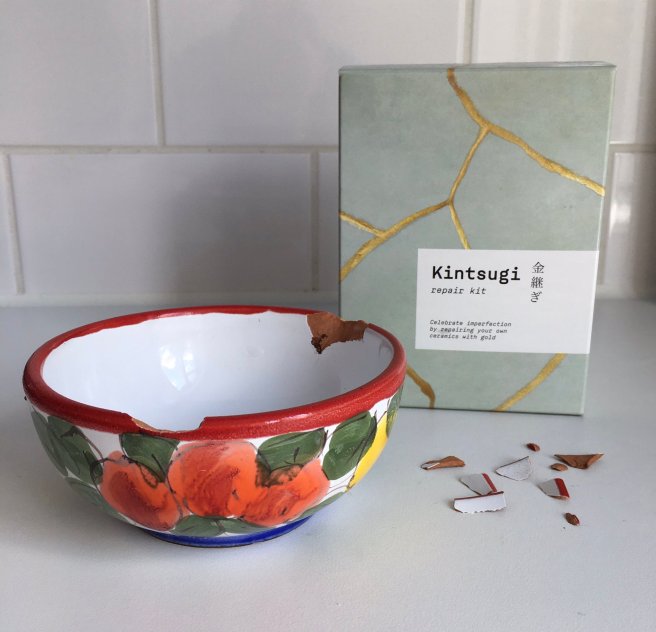
Kintsugi, or the Japanese art of mending broken ceramics using lacquer mixed with gold, silver or platinum, celebrates imperfection by treating breakage and repair as part of the history of an object, rather than something to disguise. Drawing attention to its imperfection in this way (and potentially valuing it more as a result) might appear to be counter-intuitive. If, however, you see it as a way of accepting something for what it is, it makes a lot of sense. Speaking as a recovering perfectionist, Kintsugi doesn’t just make sense to me. It’s positively therapeutic.
Despite celebrating imperfection, the best examples of Kintsugi that I have seen strike me as pretty much perfect in their imperfection. After a practice run on two small bowls that came with the repair kit (I couldn’t bring myself to break them both), it was clear that I would need to embrace imperfection to a level that would make the average Kintsugi master wince. Despite not managing to align the pieces properly and smooth the adhesive before it started setting, I was quite pleased that I had at least managed to stick the bowl back together.


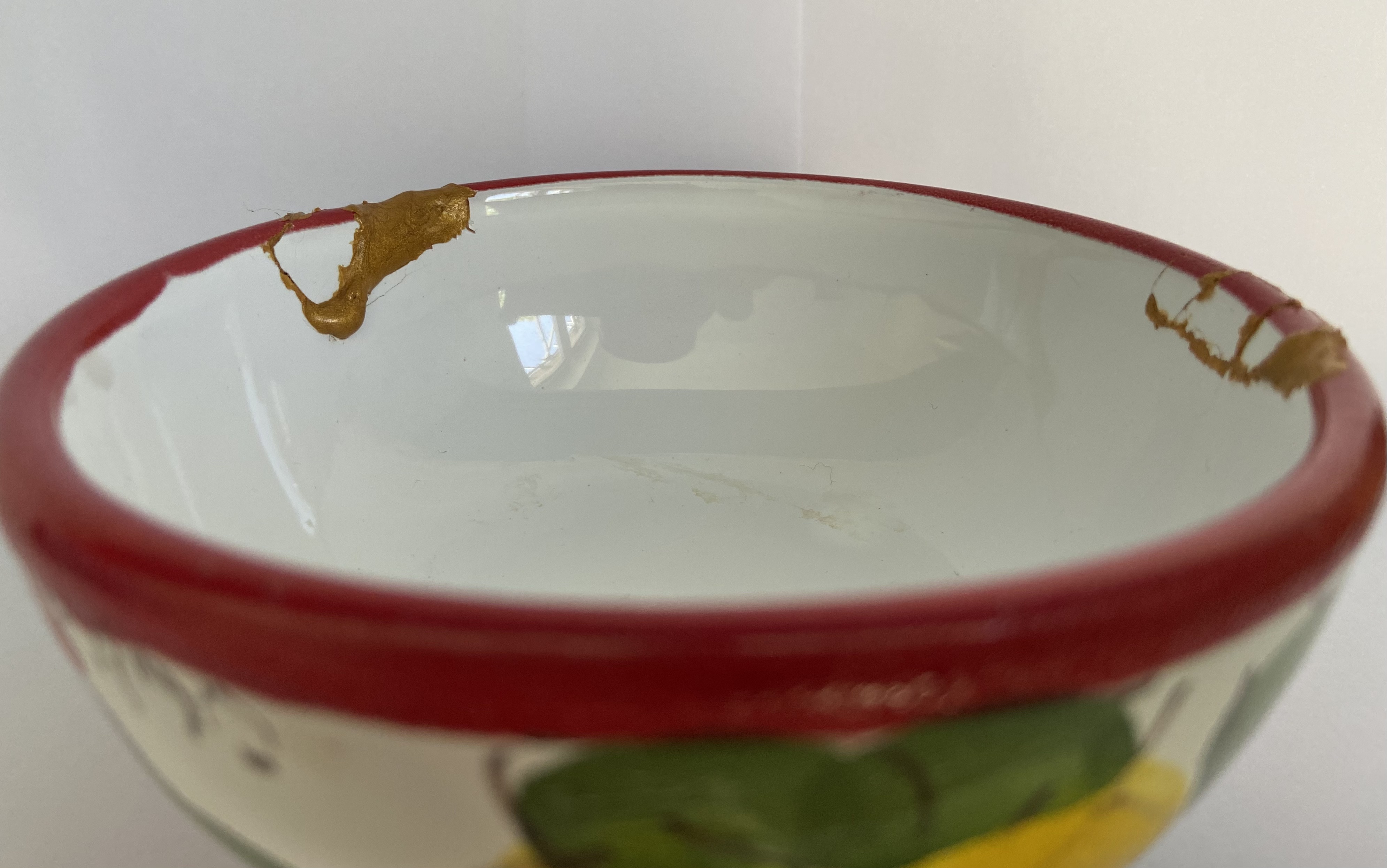
I dithered for a couple of weeks, wondering if I should practise some more, and then decided that I was as ready as I would ever be to move onto the main thing. After all, striving to be perfectly imperfect struck me as somehow missing the point of what I was trying to achieve, so I decided to go for it. I’d like to report that I managed to get everything in place without making too much of a mess before the adhesive started to set. But in the same way that you always find a sock after switching on the washing machine, I found a stray piece of the bowl on the worktop just a little bit too late. I don’t do anything by halves, so why should my attempts to embrace imperfection be any different? Let’s just say it was intentional, and call it something like Kintsugi Max.
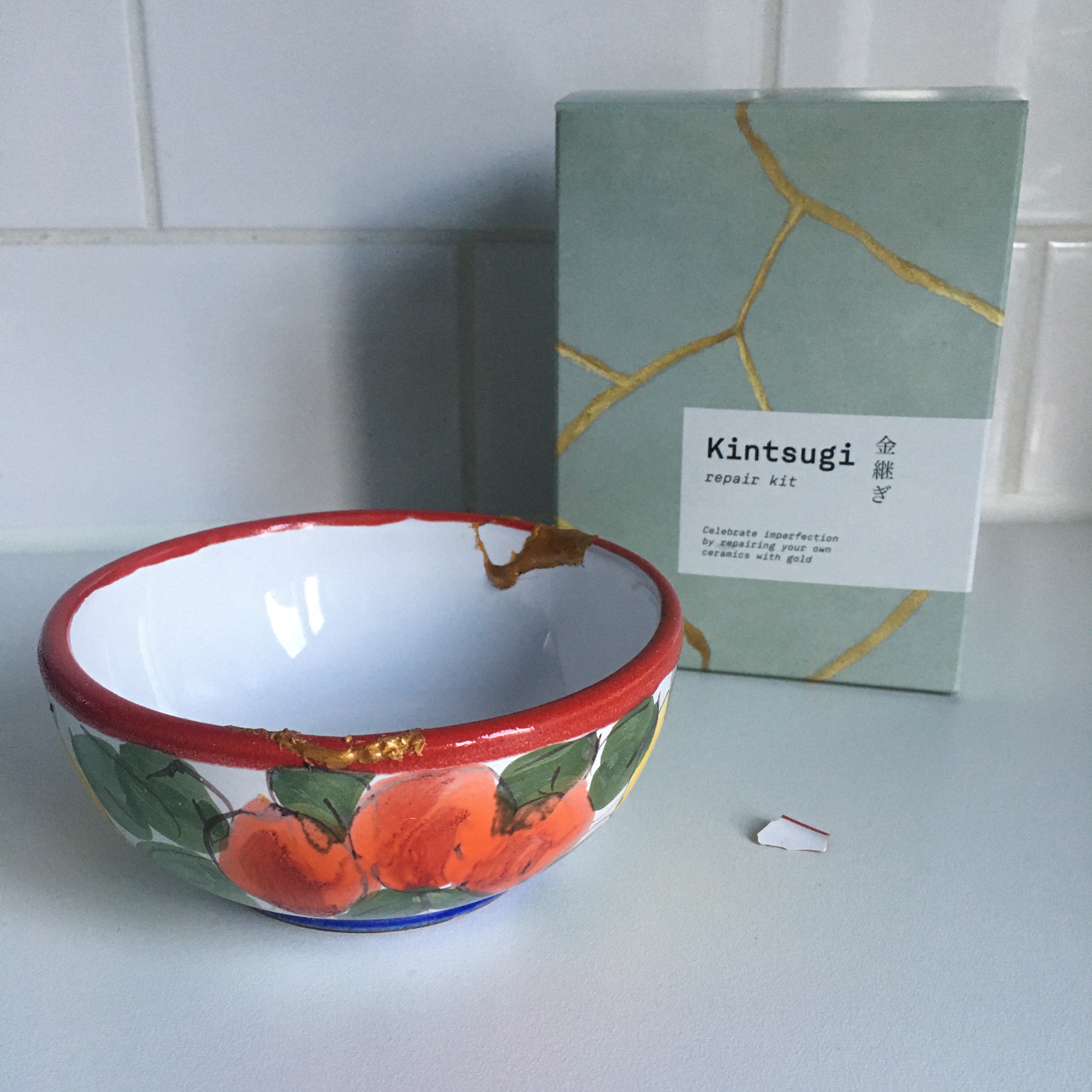
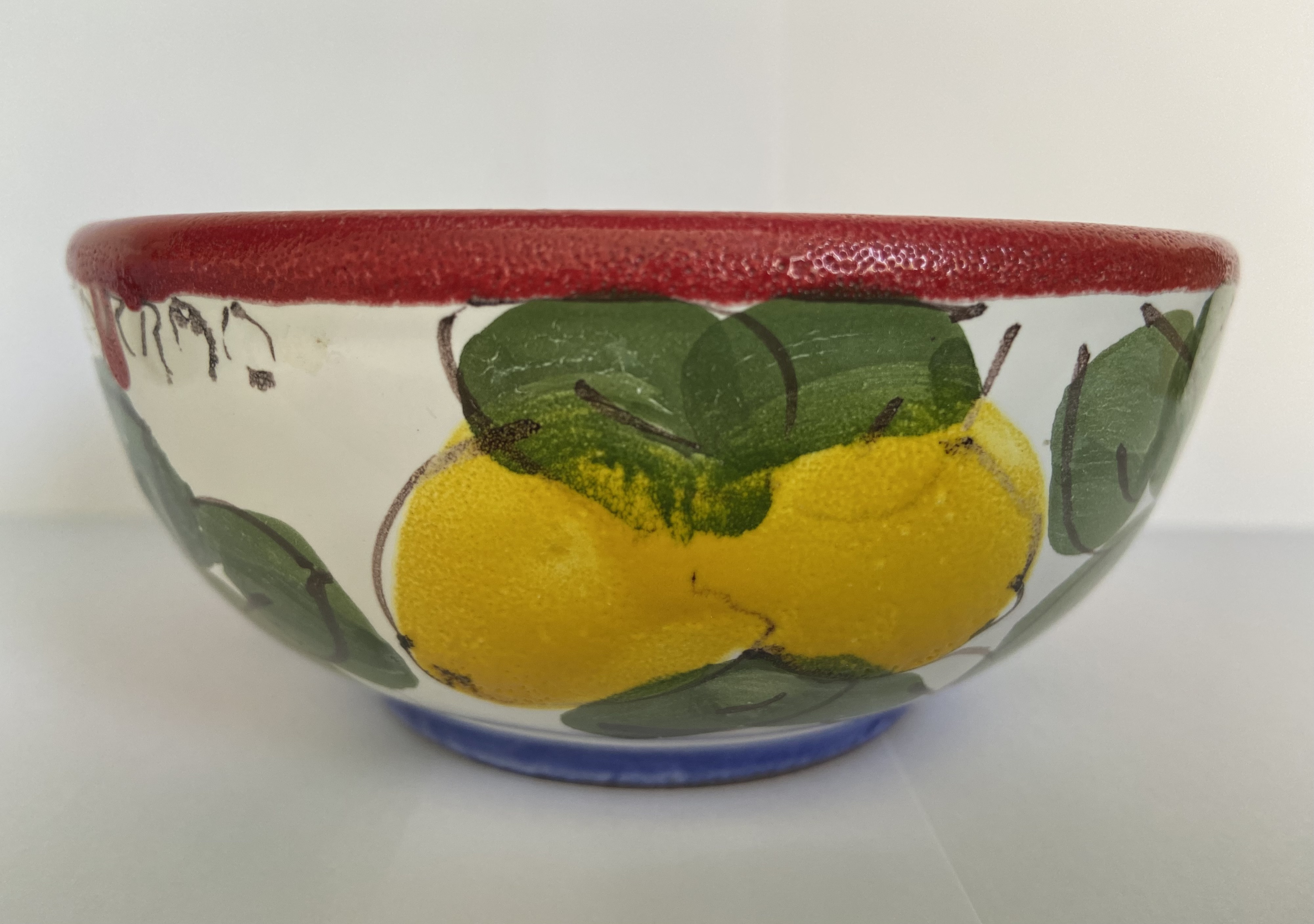
The bowl now sits by the sink in my kitchen, providing useful storage for bits and pieces, as well as a daily reminder of the importance of embracing imperfection. The fact that it was a present from my grandmother, who wouldn’t have been able to possess it if there were any sign that it had been repaired, makes the reminder all the more fitting. When looked at from certain angles, you’d never know that the bowl had once been broken. When looked at from others, it’s unmissable. Perhaps there’s a lesson in that too. If there is a portrait of me in an attic somewhere, you can bet your bottom dollar that it will be covered in cracks. These days, however, I’d like to think that they would be embellished with more than a little gold paint. It’s time to take the portrait out of the attic and display it over the mantelpiece downstairs.


 What I learned today...
Hello Geoff. I was one of your students at the College of Law in York and I am still in York. We used to hang out sometimes at Crouchy’s house ! Interesting to read your articles about Bettys. I spent lockdown learning to perfect Fat Rascals !
LikeLike
Hi there Diane! I remember those days well!!
LikeLike